My Fathers Story
My father started Bio Dynamics in 1965 which was quite a rash or unusual decision for those days. I think if we understand his upbringing and his connection with nature then we can see why that decision was made. In this part of the book I would like to add some context to those decisions by illustrating his family background.
Dons great grandfather came to the Kyabram area which was a small farming town in the North Central Region of Victoria about 210km or 130 miles from Melbourne Australia. Set in the Goulburn River Valley, Kyabram had a very flat landscape made up of cleared and natural grasslands and areas of native trees bunched here and there. It was separated by straight dirt roads (muddy in the winter and dusty in the summer) in one mile blocks which was inhabited by small farms growing everything from grass for milk production to grain, pigs and sheep etc.
The Goulburn Valley, like most inland areas of Australia had a naturally dry climate, so in order for farming to be reliable, irrigation was introduced via Lake Eildon and the creation of Waranga Basin, (a man made important off-river storage system) where water was diverted from the Goulburn River at the Goulburn Weir, via large Channels. The Basin has a capacity of about 430,000 million litres and is one of the largest storages in the Goulburn System and located between the Goulburn and Campaspe River basins, about 8 km north-east of Rushworth. This brought great promise to the whole area as far as agriculture was concerned.
Don's great grandparents were some of the first European settlers who built a house off Warren Road which came off Rathbone Road at St Germains.. You see that’s how the first roads were named by the first European settlers and the towns kept the Aboriginal names like Wyuna (which meant clear water).
The wildflowers grew naturally when my father was young but they seemed to diminish greatly after the implementation of fertilizers to our farmlands.
When George and Mary owned the 900 acre property around the Goulburn river at St Germains, they milked about 60 cows by hand, grew wheat (they used horse drawn implements in those days) and made sheathen hay. Don thought he might have made lucerne chaff to sell .
Dons’ mother lived at McCoys Bridge which was about 10km from St Germain
McCoys Bridge was built across the Goulburn River in 1941 and was the 7th longest road bridge in Victoria. Where the bridge crosses the river is of historical significance, as it was an important local route for the initial squatting of Europeans during the 1850s to 80s. The present McCoys Bridge is of local historical significance for it played a major role in providing better transport for the district during the Second World War period, as part of the development of irrigation farms. Following the war, the bridge became an important link for soldier settlement farms in the district.
Before the current bridge there was a smaller one (which I think some of the stumps still remain) and if you go back far enough there would have been a low place there, where they would have perhaps laid some rock down and would wade the horses or themselves through, when the river flows were low enough to do so.
On the farm they milked 35 cows (by hand in those days) and the dairy was at the back of the house. The dairy farm was pretty successful, he used to get irrigation from the Goulburn river to water his pastures with. I think at first they had a steam engine to drive the pump. Then later on, they had a black diesel engine.
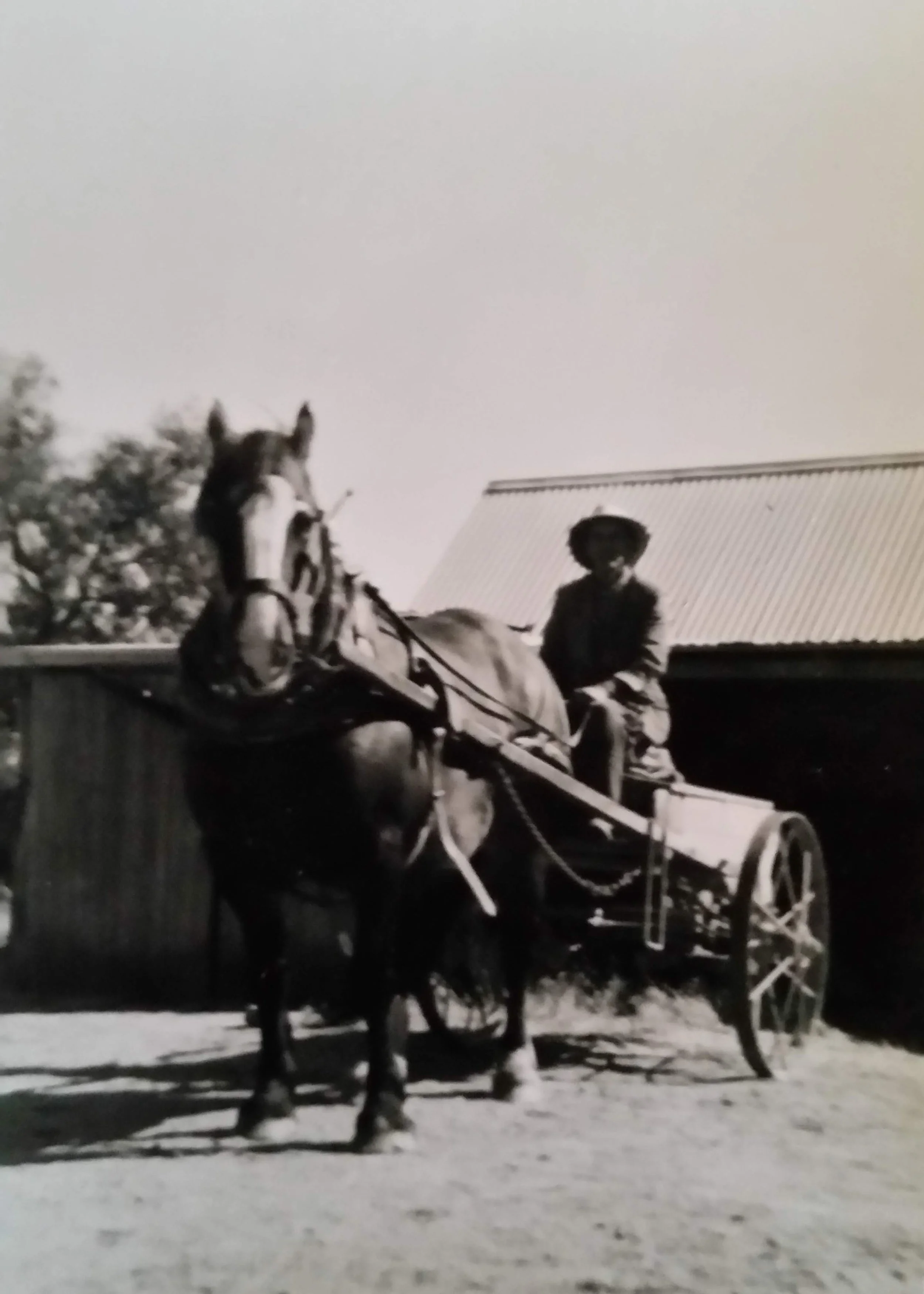
Grandfather James with his horse drawn super phosphate (fertilizer) spreader for his farm. Don thinks it was a Baltic Simplex. Not sure when this was taken.
James did a lot of contract scooping with a team of horses. He helped build the dam wall for the Waranga Basin, (as mentioned above a major Lake that provides irrigation water for the Goulburn Valley) and built channels whilst running his own farm at the same time. He would take his horses, towing a caravan to sleep in and enough food and water for himself and the horses to stay for a week at a time. His daughter Queenie drove the Overland car (at 15 or 16 yo maybe) to the Waranga Basin and back with a trailer to take extra chaff for the horses. It was probably a 2 hour return journey + unloading time, quite a feat for a young girl.
When she was even younger Aunty Queenie used to drive her younger siblings to school from McCoys bridge to Kotupna School with the horse and cart
Every school day she would have to
Catch the horse from the yard and put a collar on it, then connect the horse to the cart
Load the children and take him to school which was about 8 km away..
Take the horse off the cart, feed and water them through the school day
Catch and attach the horse to the cart again in the afternoon
- Drive the horses home again, detach them from the cart and feed and water them.
The Kotupna post office was nearby and Don used to ride his bike there to get the mail when he was on school holidays. The roads were all made of graded sand which was natural to the area. It wasn't always the easiest to ride the bike on because it was so sandy. They had the sandpit nearby and they would grade it with the horse grader originally, before the motorized graders came along.
The reason I'm listing all these facts is that I feel we don't really appreciate what our past generations went through to feed us and provide us with the good food system that makes the life Style we have now.
Don said he visited his grandparents a lot as a child, especially on school holidays. He would watch them milk the cows, then when we got a bit older we got involved with the work a bit more.
They went fishing alot in a big old row boat and caught fish like red fins or golden perch (yellow belly) in the Goulburn river and in the lagoon at the back of the house there
Don with a Murray Cod caught at McCoys Bridge When he was about 10 or 12
He caught cod in the river on springers, which was a piece of stick usually greenish that had a fishing line tied to it and bait usually a small carp or yabbie. They would leave it overnight then check them in the morning. My grandfather would row the boat and we used big aeroplane type spinners and got quite a few fish using that method.
The river was pretty clean in those days but there were some signs of algae in it but you could stick your hand in and see it.
James had trotting horses so we used to see him training them and the usual chores associated with horses.
When I used to stay with my great grandparents as a young child, I remember pictures of trotters on the walls and he was always having a bit of a bet. I can hear the radio playing the races. He had one called, Yambuna Lass which did fairly well.
I remember James stirred his tea so hard that most of it ended up in the saucer and he would tip it back in the cup. Good way of cooling it I guess.
When Stan left school he worked with his father George on the farm and did contract scooping with a team of horses and fencing. He also carted wood into the Kyabram Bakery on contract to keep the ovens burning to make daily bread.
Dons Story.
Don was born on the 7th of September 1937 at the Kyabram Bush Hospital and was brought up in a small house that his family built on Trevaskis Road Wyuna East which they moved to when he was about 2 years old. The property was about 210 acres originally but then later on they bought another 50 acres. Originally there was nothing on the farm except the bare land. The intention was to have a dairy farm and to grow some fruit .
The dairy was built by his father and then they introduced cows to the property. His mother Jean milked most of the time whilst his father went out and worked off the property for extra money. He used to contract out his team of horses, a plough and scoop to build new irrigation channels and roads in the district. The original channels branched out across the district around 1916 from the Waranga Basin, so his father mainly did upgrades and additions.
Milking by hand
They had about 60 or eighty cows and the fastest milker was Jean. She could milk 10 in an hour or 1 every 6 minutes that included getting them into the dairy, so in order to do 50 or 60 cows they had about 4 or 5 people to do them.
They had a little cream room near the dairy with a separator. They positioned it as far away as possible from the dairy for hygiene reasons. The separator had many dishes which had to be dismantled and washed, then hung out in the sun to dry everyday. This was their antibacterial treatment in those days.
Many people who started farming in the early days were shearers or contractors and would do that kind of work every year to support their farm. Some of the people who were on farms were returned Soldiers from the Second World War, who had special allowances or support from the government to allow them to do so.
Most people were multiskilled, “Not only did my parents have to build the house and the dairy but they had to organize for all the fences to be built on the original property as there was none.” Don said.
When I asked Don if there were more trees around when he was a teenager compared to what there is now he replied.“ no not really"
Redgum River country at St Germains was classed as pretty poor but worse still worthy grassed areas which were pretty much classed as Kangaroo Country at Wyuna on the plains just east of there. Wyuna East had a more undulating landscape, with old riverbeds and richer soil.
So where did the fence posts come from?
“My grandfather had a 900 acre property around the Goulburn river at St Germains, where Stan used to cut his own fence posts.”
It wasn't until Don was about 7 years old that they planted the first fruit trees around 1944. He remembers the first pruning of the small trees at that time and the peaches were the first to be harvested. They had planted approx 14 acres of orchard overall, apricots and peaches mostly and a few extra pears. The fruit went to the Kyabram Cannery or it was called the Kyabram preserving company commonly known later as KY Fruit, which canned sliced fruit in sugary syrup and made some jams.
They picked all the fruit into wooden cases which were roughly sorted before they went off to the Cannery but sometimes they were put on a sorting table before sending off to market. All the fruit that wasn't suitable for market was fed to the pigs and some of it would go to the dairy cows so nothing was wasted. There wasn't much wastage as the cannery took most of it for jam but it depended on how much supply and demand there was within the local area at the time.
To fertilize the farm they applied a small amount of superphosphate which was the only thing available in those days.They would put half a bag or up to 1 bag per acre (12 bags in a ton). That gradually increased over the years up to sometimes two or three bags per acre but that was a bit of an experiment because the normal was one bag. There was no weed killer in those days but they did spray insecticides for a pest known as Codling Moth.
Codling moth is one of the major pests in the fruit growing industry, especially on apples and pears. The larvae are highly attracted to fruits as a food source and bury into the fruit as they eat it. This leaves a mark on the outside of the fruit plus the worm leaves an unsightly brown mess inside especially around the core thus this had a significant impact on the sale of crops.
In the old days they used Bluestone (copper sulfate) and lime, basic minerals to stay on top of fungal diseases. Later they used arsenic on the pears for codling moth.The arsenic powder was mixed with about 125 gallons of water and put into the spray tanks which was driven by a Ronaldson Tippett engine driving a pump which put the spray into hoses and they would walk behind the pump spraying the trees individually. Then arsenic of lead was banned as a spray and we started using DDT. It too was later banned. Then they started using things like Malathion. They had people at the time who were advising that these chemicals were the ones to use and were safe to do so.
Note: It’s funny how all those things are banned now. Was there good science out on this or were they just guessing and are they still just experimenting with poison on food.
Most of the picking was done by family and then the neighbors would pitch in and help from time to time. The fruit was grown with some nitrogen fertilizer after the war years.
Sulfate of ammonia was also used. It wasn't till he left school and was working on the orchard full time that he was aware of exactly what chemicals and fertilizers were used.
As children they were expected to help out on the farm like picking up of prunings and as they got bigger, they did some of the pruning themselves .They used to go around the trees on the weekend with the horse and a big metal drum with a fire in it and would burn the prunings.
The Orchard was cultivated with a horse drawn mouldboard plough mainly to keep the weeds down. Later on they got a set of discs to do that job.
Having irrigation on our farm was a pretty big thing in those days. Their first grader was made out of wood. There were no pipes and plugs for irrigation channels in those days, we would just open cuts in the channel bank with a shovel.
The trees were all irrigated using small farrows that were flooded right next to the trees. The furrows were made with a petty plough.They used to feed the small furrows by making channels with the mouldboard plough from the main channel.
The initial flavors from fruit were pretty good as they didn't use much fertilizer. The fruit had to be a certain size and color to satisfy the factory. Don thought they were pretty fussy.
When the nitrogen fertilizers came along the size of the fruit was boosted a bit more. Sulfate of ammonia was used after the war years but when nitrate of soda came out you could see where you put it on the soil and it would tend to make it hard.
They didn’t have power out at the farm until 1951. My mother said “ they had power at Rochester in 1926”, I suppose it took a while to get the poles out to all the farms etc. We had phones early on but when they put the power on, they used the phone poles and disconnected the phone lines for a while.
When Don's mother was sick after giving birth to her youngest daughter, Don's father Stan went out to the poles and reconnected the phone lines, so he could call to see how his wife was doing in the Echuca Hospital.
So before 1951 the milking machine was powered by a little stationary diesel engine and the cream separators had a little engine also.
At this time they bred up as many cows as they possibly could and started to get the manure from the dairy and put it around the orchard fruit trees. This brought up a lot of weeds because of the grass seed in the manure.The early peaches were picked around the end of February then they had different varieties that were picked in March and April. So there was a regular supply throughout the season.
Before I came home from school mum's main job was to milk the cows whilst dad attended to other things like irrigation. After milking she would cook breakfast and get the kids off to school she would then have her household chores like washing, cleaning and then cook lunch for all of us and sometimes neighbors who would be helping out on the farm. This was usually a roast but in the summertime it may include cold meat and veggies.
Kathy Barker (a long-time neighbor of ours) told the story that when Don was born his mother used to put him in a pram and walk a mile and a half to the dairy while she milked the cows and then return after milking another mile and a half. While she was milking the cows she would check on me regularly.
When Don was about 12 years old I had to milk the cows before I went to school at Wyuna East and we had to be there by 9am ( which was a 5 -10 minute walk down the corner)
Pic of the school here there one of Grandad somewhere
It was a little more difficult when he went to Tongala consolidated school because the bus left at 8 a.m.
Cow Health .
The cows seem to be in good health and Don doesn't remember drenching them at all. If one became sick they would give a laxative type drench. At times some of the cows got Milk fever, a disease which occurs in cattle following calving, when demand for calcium exceeds the body's ability to mobilize it. Milk fever is more commonly seen in older animals and the signs include restlessness, tremors, ear twitching, head bobbing then the affected cow can no longer stand and appears dull. If this persists for too long they can sometimes become weak and die. The scientific community didn’t have a remedy for it in the early days but later on that they came up with calcium injections.
The only other injection we gave them was an immunization called ‘Strain19’ for brucellosis in the early days which eventually was phased out. That was most of the things they used in the early days as far as cow medicine was concerned but cow drenchs came along a bit after that in the early nineteen sixties.
How many litres or gallons of milk did you get in those days?
We didn’t give it much attention in those days, it was whatever we got.
Stan used to get up at about 4 a.m. and in the summertime he would go around the water and get the cows in, usually on a horse in winter time but in the summer he might use the pushbike. They would then milk the cows in the dairy which was a walk through system, there was a yard full of cows, you would get one of the cows into a stall usually with a small amount of feed to calm her, then shut her in and you would crouch down or sit down on something like a small stool or bucket and put the milking machines on. Later we upgraded to a six cow walkthrough and got new milking machines. To milk 60 cows it would take about an hour and a half to 2 hours but then another 1 hour would be needed to separate the cream off into cream cans. Then the factory would pick up the cans later in the day and it would be made into butter.
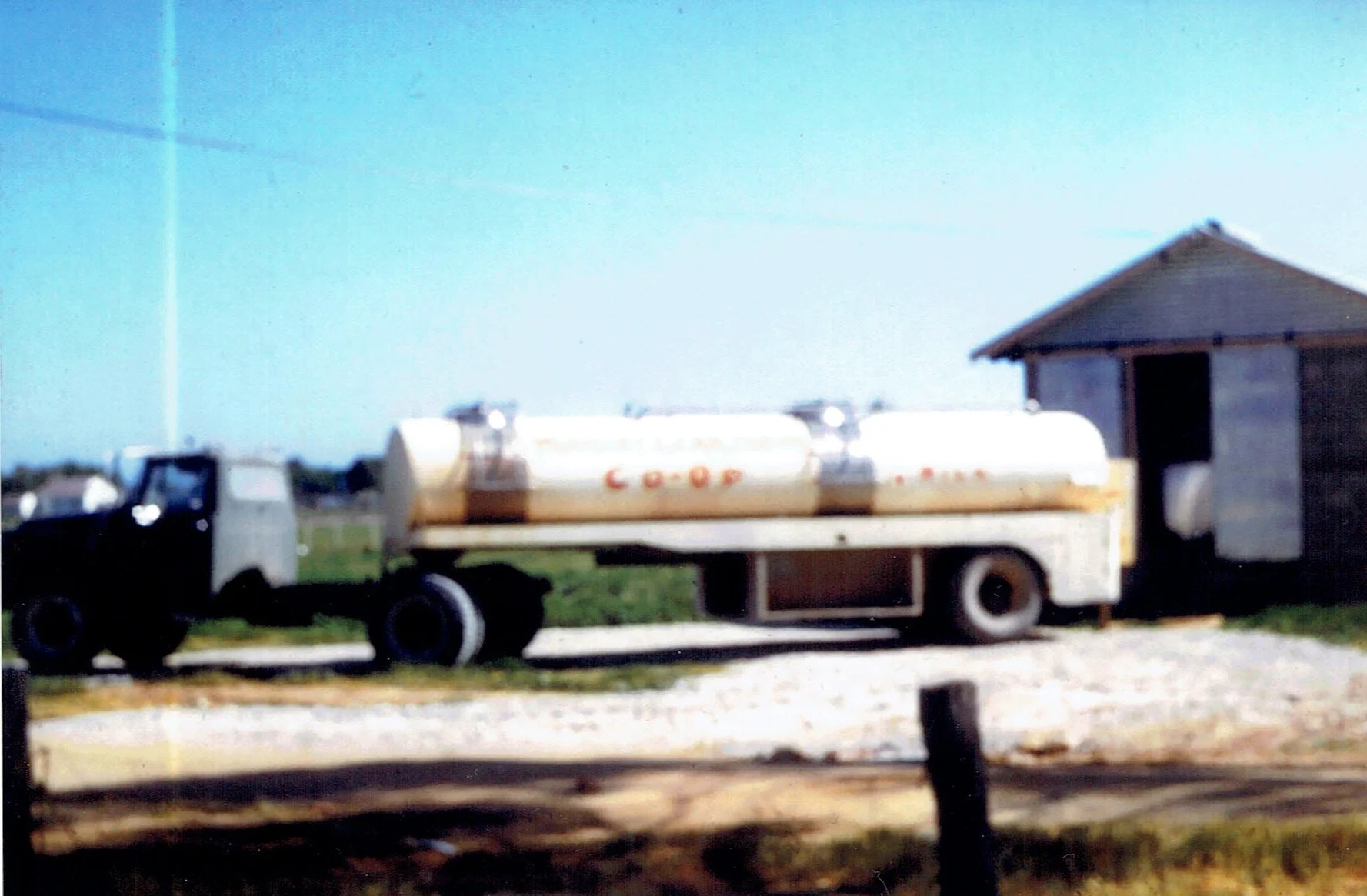
Before refrigeration the milk would go into cans like this
The Milk would go into a vat and when it was full we would have to switch on the electric separator which made it into cream. One of the secondary products from separating cream off was of course skim milk, this would go off to the pigs. Which you would feed after milking. The pigs also got the waste fruit.
We first started by carrying buckets out to the piggery but later on we got a skim milk pump and piped it over. We had about 10 sows, who might have 8 piglets each and they might do that twice a year if you were lucky. They had a livestock market in our local town Kyabram where you could sell cattle and sheep. You could raise 120 to 150 pigs a year which was quite good.
How did you store the cream.
It would go into large cream cans with a lid on it and put in like a Gilgardi safe which kept the flies out. Then it would be picked up twice a week by Carnation from Merrigum. It would be pasteurized and made into butter. Cream seemed to keep much better than milk even in the heat. It must have something to do with the fat content.
Before Stan bought his first farm, he used to work all day contract road building with his team of horses and then go out at night time and do contract fencing by kerosene lantern.
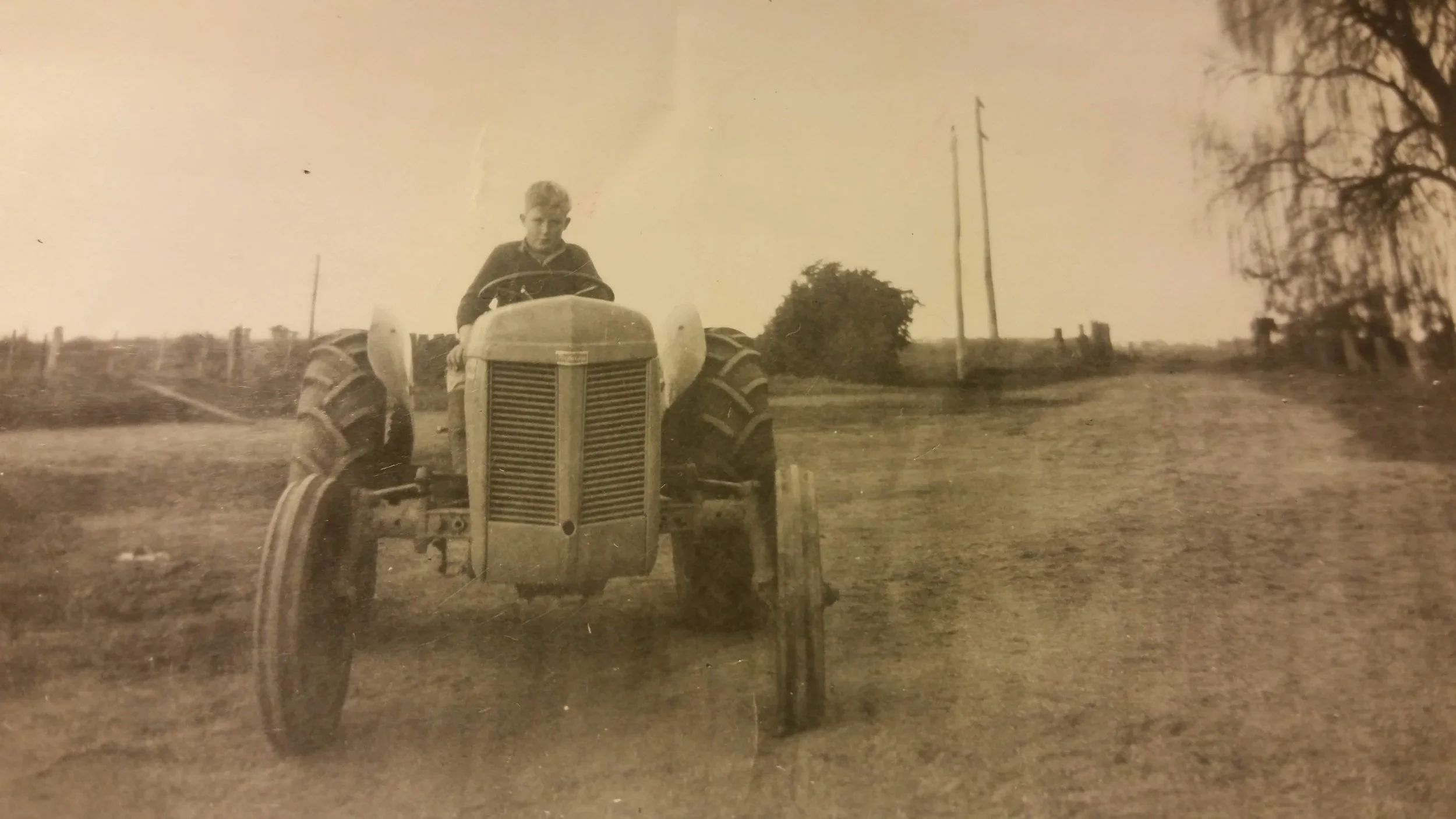
When I was fifteen years old I left school to help Dad on the farm this was also when we got our first tractor. It was a brand new grey Ferguson. That was the first tractor that we ever bought. There was no tractors around before that so they sold heaps of them at Albion Motors in Kyabram around that time.
Picture of a tractor with a young Donald on it at there home farm at Trevaskis Road.
What was the first implement to put on the new Ferguson tractors?
The first job we did with it was plough a paddock with a 1 way disc plough which was normally horse drawn. We then bought a mouldboard plough and a Ferguson mower.
a bit smaller than thisWhat did an average day look like ?
After milking the cows in the summer the priorities would be irrigating of course and picking fruit. In the winter we did a lot of pruning on the 14 acre orchard. My my main job on the farm when I left school in the morning especially in the winter was to catch the horse and load up a trailer with Shethan Hay, squares bales and some loose grass, to feed all the animals which was about 60 cows then 30 heifers and calves. We would do the pruning of course, fencing that needed doing and then milk the cows in the afternoon.
In the summertime we did a lot of hay carting and made a few squares with some loose hay which we would hand fed into a baleStans’ main job in the spring and summer was cutting hay with a sickle mower and then raking it with one of those tyned carriages. You would drag the hay along until you got to a point in which you would flicked a lever and it would dump what you'd collected into a row ready for baling. This would be done with a horse towing the rake.
Contractors would come in and do the bailing with a self propelled baler. After the hay was done fruit picking was the next priority.
In 1955 my family bought a 260 acre farm on Goddard Road where later Don started his own business.
When they took the property over it was a sheep grazing property, which had fat lambs and sheep for shearing . Don said in those days farming was pretty good you could sell a semi trailer load of sheep and buy a new car or tractor or maybe even both.
The property had been very heavily stocked and had an old house, an old machinery shed, a shearing shed and a few fences and that was about it.
Don and Margeret got married in 1961 and officially took over management.
C Copyright Mark Rathbone 12/12/24.